


Preparing for the Future: A Guide to Java AP, Machine Learning, and Competitive Coding for Kids
- Feb 20
- 4 min read
With today’s advances in technology, coding is developing into a core competency equivalent to basic literacy (reading/writing). Many parents wonder not whether their child should learn to code but what specific coding skills they should focus on developing.
Once your child moves from the initial stage of 'drag and drop' coding games, there are so many choices available, including should the Child Study for a School Exam? Should they be competing in Coding Competitions? Should they be learning about cutting-edge technologies such as Artificial Intelligence (AI)?
We’ll break down the three top pathways available for intermediate and advanced students into 3 groups: Java AP Classes for Kids; Competitive Coding Classes; & Machine Learning Courses for Teenagers.
Java AP Classes for Elementary Students: Advanced Placement (AP) classes are commonly part of high school or student preparation for high school. The AP Computer Science A exam represents the highest level of achievement for a computer science student.
The purpose of taking Java AP Classes for kids is to prepare students to pass the AP Computer Science A exam by becoming proficient with the Java programming language. Why choose the Java programming language?
Java is one of the most common programming languages used throughout the world. Java is the programming language used to build Android apps and is also used extensively in corporate environments.

Within an AP Computer Science A class, students will learn Object-Oriented Programming (abbreviated OOP). OOP is just a programming technique used to organize code by modelling code in programming to represent how objects are represented in the real world.
Taking these classes will give any student the following benefits:
Earn College Credit: Passing the AP exam with a qualified score will qualify for college credit as a college class.
Discipline Development: Java requires exactness and precision in code, which teaches discipline to students.
Transcripts Show Student has Challenged Themselves: Colleges consider students that challenge themselves with rigorous academic courses in the STEM fields favourably.
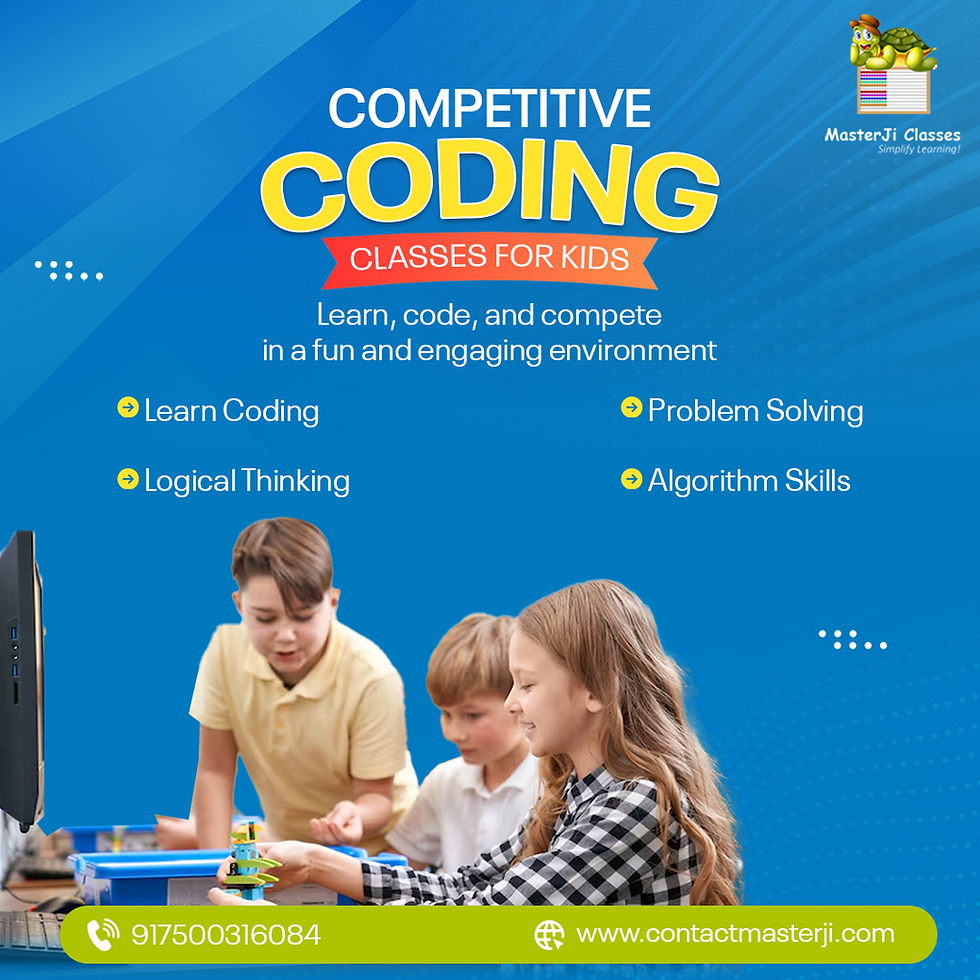
Competitive coding classes offer an avenue for kids who are interested in code competition through solving logic-based puzzles, riddles or math-related challenges. In competitive coding, instead of building an app or website, students are required to complete a complex logic question and create a program to solve the question in as little amount of time and as efficiently as possible.
Competitive coding classes focus on the following:
Learning algorithms (the predetermined way of solving a particular problem e.g. sorting a list of numbers or finding the shortest distance between two points) Writing code that runs quickly and doesn't crash How to prepare for contests. Some of the competitive coding classes prepare students for contests such as the USA Computing Olympiad (USACO).
This approach to coding has demonstrated to assist in developing deep critical thinking skills. Completing logic problems teaches how to break down a complex, overwhelming problem into small, easy-to-manage components which will benefit an individual in any profession.
For the Innovator: Courses on Machine Learning for Teens
AI has become a common word (not just a buzz word) in today’s culture and its everywhere you look; from the algorithms used to recommend TikTok videos all the way to the autonomous vehicles driving down our streets.
Machine Learning Courses for Teenagers give you an opportunity to look behind the curtain and see how the magic happening with AI works and it’s fascinating! In the past this has been an academic course taught only at the University level; thanks to a plethora of modernized tools available now, it is no longer exclusive to academics; it has now been made available to High School students.
Teenagers enrolled in Machine Learning Courses work primarily with the Python programming language as they do the following:
Analyse Data: Learn how machines find patterns in numbers through data analysis (e.g. a computer can tell if a picture contains a cat or a dog)
Build Models: Develop applications that will allow machines to find images (e.g. a computer can determine the difference between a cat and a dog) or predict what’s likely to happen in the future (e.g. stock market prices)
Understand Ethics: Discuss the ethical responsibilities associated with developing machines that make artificial intelligent-based (AI) decisions.
Machinery Learning Programs have proven to provide an awesome avenue for encouraging young adults to have a better understanding of the future, the capability of themselves, and how they can create projects that appear intelligent and/or interactive.
Which Path is Right?
There is no wrong choice here.
If your child wants to secure college credit and learn a structured, professional language, look into Java AP Classes for Kids.
If your child loves math, puzzles, and competition, Competitive Coding Classes for Kids will keep them challenged.
If your child is fascinated by AI and wants to experiment with data, Machine Learning Courses for Teenagers are the way to go.
The most important step is simply getting started. Giving your child the tools to understand technology ensures they won’t just be consumers of the future—they will be the ones building it


Coding has truly become a fundamental skill, and there are several great ways to approach it depending on what sounds most interesting. For example, Java AP classes are a solid choice for learning a professional language while earning college credit. If solving puzzles and using math is more your thing, competitive coding focuses on using algorithms to tackle complex problems and build critical thinking. There are also machine learning courses that use Python to help teenagers understand how AI works by looking at data patterns.
Sometimes jumping into these advanced topics can feel a bit intense, especially when you're trying to balance regular schoolwork with new, complex concepts. If the workload ever starts to feel like too much to handle at once, getting…